
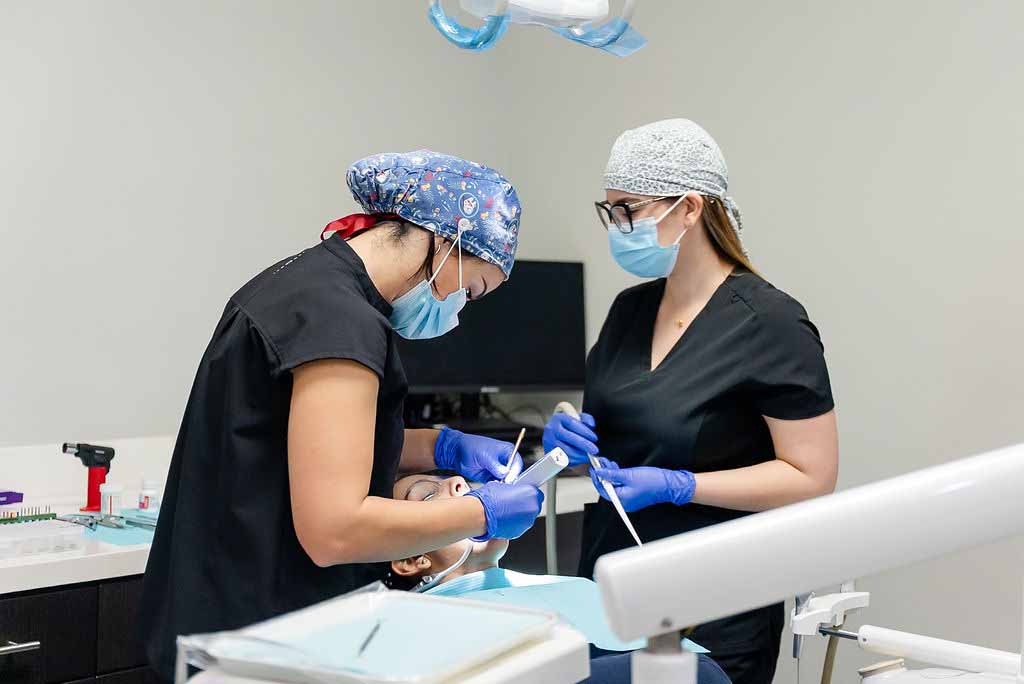
When a tooth starts hurting, breaks while you are eating, or suddenly becomes sensitive to hot and cold, one of the first questions patients ask is:
“Can this tooth be saved, or does it have to be pulled?”
Many patients also search online for:
“root canal near me”
“root canal West Palm Beach”
“dentist for broken tooth near me”
“broken molar dentist”
“root canal or extraction”
“can my broken tooth be saved?”
At Blue Hearts Dental in West Palm Beach, we evaluate broken teeth, deep cavities, dental infections, and tooth pain to determine whether the tooth can still be saved.
When a tooth has a good long-term prognosis, root canal treatment may allow you to keep your natural tooth instead of having it extracted.
For our Spanish-speaking patients, root canal treatment is also commonly called tratamiento de conducto.
Not every toothache requires a root canal, however, and not every damaged tooth can be saved.
The first step is getting the right diagnosis.
What Is a Root Canal?
Inside every tooth is an area containing dental pulp, commonly referred to as the nerve of the tooth.
The pulp contains nerves and blood vessels.
A deep cavity, fracture, trauma, or other dental problem can cause the pulp to become irreversibly inflamed or infected.
During root canal treatment, the inflamed or infected tissue inside the tooth is removed. The root canals are then cleaned, disinfected, and sealed.
The goal is to eliminate the source of infection or inflammation while preserving your natural tooth.
How Do I Know if I Need a Root Canal?
Symptoms can vary significantly from patient to patient.
Some people experience severe pain.
Others can have a significant dental infection with surprisingly little discomfort.
Possible signs that the nerve of a tooth needs to be evaluated include:
- Severe toothache
- Pain that starts spontaneously
- Pain that wakes you up at night
- Lingering sensitivity to hot or cold
- Pain when biting
- Pressure around a tooth
- Swelling
- A small bump on the gum
- Bad taste or drainage
- Darkening or discoloration of a tooth
- A severely broken tooth
- A very deep cavity
Having one of these symptoms does not automatically mean you need a root canal.
A dental examination is needed to determine the actual cause.
My Tooth Hurts With Cold. Do I Need a Root Canal?
Not necessarily.
Brief sensitivity to cold can occur for many reasons, including gum recession, a small cavity, tooth wear, or a recent dental restoration.
One symptom that can be more concerning is pain that lingers after the cold or hot stimulus has been removed.
Pain that starts on its own without eating or drinking can also indicate a problem with the pulp.
Your diagnosis should be based on your symptoms, examination, dental X-rays, and appropriate testing rather than one symptom alone.
Why Would a Broken Tooth Need a Root Canal?
A tooth can break because of:
- A large cavity
- An old, large filling
- Biting something hard
- Clenching or grinding
- Trauma
- Weakening of the tooth over time
If the fracture is limited and does not involve the nerve, the tooth may only need a filling or crown.
But when a fracture or deep cavity reaches the pulp, the nerve can become inflamed or infected.
In that situation, root canal treatment may be necessary before the tooth can be restored.
Can a Badly Broken Tooth Still Be Saved?
Sometimes, yes.
A tooth that looks severely damaged does not automatically have to be extracted.
We need to evaluate:
- How much healthy tooth remains
- How deep the fracture extends
- Whether the root is intact
- The amount of supporting bone
- Gum health
- Whether enough structure remains to restore the tooth
- The expected long-term prognosis
Some badly damaged teeth can be restored with root canal treatment, a buildup, and a dental crown.
Other teeth may be fractured too deeply or have damage that makes predictable restoration impossible.
Root Canal vs. Extraction: Which Is Better?
There is no single answer for every patient.
If a tooth can be saved and has a favorable prognosis, keeping your natural tooth is an important option to consider.
Treatment may include:
Root canal + buildup + dental crown
If the tooth is severely fractured, has insufficient support, or has a poor long-term prognosis, extraction may be the more appropriate treatment.
After an extraction, you may also need to consider replacing the missing tooth with:
- A dental implant
- Dental bridge
- Partial denture
- Another restorative option
That is why comparing only:
“Which one is cheaper today?”
does not always tell the full story.
An extraction can cost less initially, but replacing the missing tooth later may change the total cost considerably.
Does an Infected Tooth Always Have to Be Pulled?
No.
Many infected teeth can still be treated with root canal therapy if the tooth is restorable.
Root canal treatment removes infected tissue from inside the root canal system while allowing the patient to keep the tooth.
However, if a tooth has a severe fracture, extreme loss of structure, advanced periodontal disease, or another condition that gives it a poor prognosis, extraction may be necessary.
An infection by itself does not automatically mean the tooth cannot be saved.
Can I Take Antibiotics Instead of Getting a Root Canal?
Antibiotics may be appropriate in certain situations, particularly when there are signs that an infection is spreading.
However, antibiotics do not remove infected tissue from inside the tooth, repair a fracture, or eliminate a deep cavity.
Symptoms may temporarily improve, but the original dental problem can remain.
If the tooth requires root canal treatment or extraction, definitive dental treatment will still be needed.
Does a Root Canal Hurt?
This is one of the most common concerns patients have.
Local anesthesia is used to numb the tooth and surrounding area during treatment.
The purpose of a root canal is to treat the inflamed or infected tissue that may already be causing significant pain.
Some temporary tenderness can occur afterward, particularly if the tooth was very inflamed before treatment.
Every patient and every tooth is different.
How Long Does a Root Canal Take?
The time depends on which tooth is being treated and the complexity of its root canal anatomy.
Front teeth generally have different anatomy than premolars and molars.
Molars can have multiple canals and more complicated anatomy.
Some root canal treatments may be completed in one appointment, while others may require additional visits depending on the clinical situation.
Do I Need a Crown After a Root Canal?
Not every root canal-treated tooth requires exactly the same restoration.
However, back teeth that have lost a significant amount of tooth structure often need additional protection.
A dental crown may help protect a weakened tooth from future fracture.
Your dentist should evaluate how much healthy tooth structure remains and recommend the restoration that provides the best prognosis.
What Happens if I Don’t Get the Root Canal?
It depends on the condition of the tooth.
If the pulp is irreversibly inflamed or infected, the condition usually does not resolve on its own.
Pain may become worse.
Sometimes the pain may temporarily disappear as the nerve loses vitality, but that does not necessarily mean the tooth has healed.
An infection may continue developing around the root.
If root canal treatment has been recommended, it is important to understand the diagnosis and what may happen if treatment is delayed.
Can a Tooth Be Infected Without Hurting?
Yes.
This is why a dental X-ray can sometimes reveal a significant problem even when a patient says:
“But that tooth doesn’t hurt.”
Once a nerve loses vitality, the tooth may stop producing the same type of pain even though infection continues around the root.
Some patients also develop a small drainage point on the gum that reduces pressure and therefore reduces discomfort.
No pain does not always mean no disease.
I Have a Bump on My Gum. Could It Be a Dental Infection?
Yes.
A small bump near a tooth may represent drainage from an infection around the root.
Patients sometimes describe it as:
“a pimple on my gum”
“a bump that comes and goes”
“a spot that drains”
Even if it does not hurt, it should be evaluated.
Depending on the source, treatment may include root canal therapy, periodontal treatment, extraction, or another procedure.
What if My Tooth Is Broken Below the Gumline?
The depth of the fracture matters.
Some fractures that extend slightly below the gumline may still be restorable.
Others extend too deeply or involve the root itself.
In those cases, saving the tooth may no longer be predictable.
A clinical examination and dental X-rays can help determine what options remain.
How Much Does a Root Canal Cost in West Palm Beach?
The cost of root canal treatment depends on several factors, including:
- Which tooth needs treatment
- The complexity of the root canal anatomy
- Whether the tooth has previously received root canal therapy
- What restoration is needed afterward
- Your dental insurance
- Your remaining benefits
That is why the question:
“How much does a root canal cost?”
does not always have one answer.
It is also important to ask about the complete treatment cost.
For example, some teeth may require:
Root canal + buildup + crown
rather than root canal treatment alone.
Looking for an Affordable Root Canal in West Palm Beach?
Patients frequently search for:
“affordable root canal near me”
“cheap root canal near me”
“low-cost root canal West Palm Beach”
Cost matters.
At Blue Hearts Dental, we are proud to offer reasonable, competitive dental pricing and to explain treatment and expected costs clearly before beginning.
Our goal is to help you find an option that makes sense both clinically and financially.
Does PPO Dental Insurance Cover Root Canals?
Many PPO dental plans provide benefits for root canal treatment, although coverage depends on the individual plan.
Your benefits may include:
- Deductible
- Copay or coinsurance
- Annual maximum
- Frequency or other limitations
- Network requirements
Our team can review the benefit information available through your plan and help you understand your estimated responsibility before treatment.
Does Medicare Advantage Cover Root Canal Treatment?
Some Medicare Advantage plans include dental benefits that may apply to root canals, crowns, and other restorative procedures.
However, benefits vary significantly between plans.
Coverage may depend on the specific plan, network participation, annual benefits, and other requirements.
That is why we review each patient’s individual benefit information rather than assuming all Medicare Advantage plans work the same way.
What if I Don’t Have Dental Insurance?
Not having dental insurance does not mean you should continue living with a broken or painful tooth.
Ask about the cost of the examination, necessary X-rays, and recommended treatment.
At Blue Hearts Dental, you can also ask about available payment options and, when clinically appropriate, whether a larger treatment plan can be organized in a more manageable way.
If cost is a concern, let us know.
We would rather help you understand your options before a dental problem becomes more complicated.
What if My Tooth Cannot Be Saved?
If the evaluation shows that the tooth has a poor prognosis and cannot reasonably be restored, we can discuss extraction and what comes next.
Depending on which tooth is being removed, replacement options may include:
- Dental implant
- Bridge
- Partial denture
- Other restorative options
Not every missing tooth needs to be replaced in the same way.
This is also where our guides about tooth extractions in West Palm Beach and dental implants can help you understand your next options.
Have a Broken Tooth or Toothache in West Palm Beach?
You do not need to know whether you need a root canal before you call.
You can simply tell us:
“My tooth hurts.”
“I broke a tooth.”
“Cold makes my tooth hurt.”
“I have a bump on my gum.”
“I was told I need a root canal.”
“I want to know if my tooth can be saved.”
That is exactly what the dental evaluation is for.
At Blue Hearts Dental in West Palm Beach, our goal is to determine what is causing the problem and clearly explain your available treatment options.
We see patients from West Palm Beach and surrounding Palm Beach County communities, including Greenacres, Palm Springs, Royal Palm Beach, Wellington, and nearby areas.
We provide care in both English and Spanish.
Can Your Tooth Be Saved? Start With an Evaluation
A broken or painful tooth does not automatically mean you have to lose it.
Depending on the condition of the tooth, a filling, crown, or root canal treatment may allow you to keep your natural tooth.
And if the tooth truly cannot be saved, we will explain why and discuss the alternatives.
At Blue Hearts Dental, we believe patients should understand:
- What is causing the problem
- Whether the tooth can be saved
- Which treatment is recommended
- The expected prognosis
- How insurance benefits may apply
- What costs to expect
Blue Hearts Dental
West Palm Beach, Florida
Have tooth pain, a broken tooth, or were told you need a root canal? Call to schedule an evaluation and learn about your options.
Reviewed by Dr. Yanelis Perez, DMD
Blue Hearts Dental
West Palm Beach, Florida
This article is intended for general educational purposes and does not replace an individual dental evaluation. Diagnosis, prognosis, recommended treatment, cost, and insurance benefits depend on each patient’s individual condition and plan.