
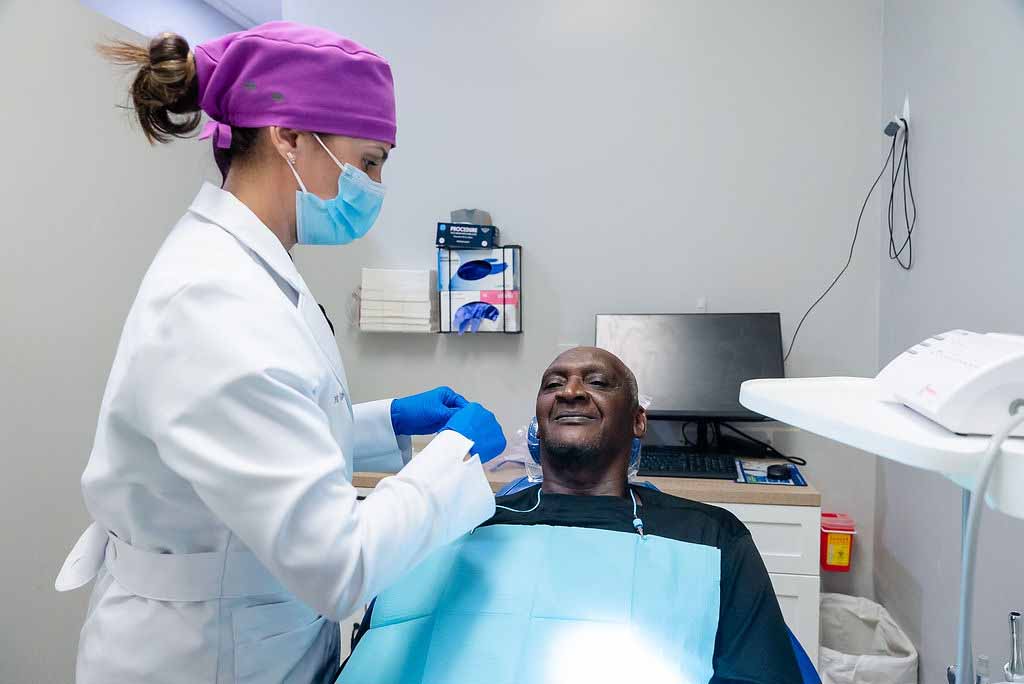
A toothache can start as a small annoyance and quickly become a problem that keeps you from sleeping, eating, or concentrating.
Other dental emergencies happen suddenly. A tooth may break while eating, a crown may come off, swelling may develop around a tooth, or you may begin experiencing severe pain when you bite.
If you are looking for an emergency dentist in West Palm Beach, the most important thing is knowing when you should seek dental care and what you can do while waiting for your appointment.
At Blue Hearts Dental in West Palm Beach, we see patients with tooth pain and other urgent dental problems. Our first goal is to determine what is causing the problem, help relieve your discomfort when possible, and explain your treatment options clearly.
What Is Considered a Dental Emergency?
Not every dental problem requires treatment within minutes, but certain symptoms should not be ignored.
Severe or persistent tooth pain may be caused by a deep cavity, inflammation of the dental nerve, a cracked tooth, an infection, or a problem with the gums surrounding the tooth.
You may also need prompt dental attention if you have:
- A broken or cracked tooth
- Facial or gum swelling
- A dental abscess
- A crown that has fallen off
- Severe pain when biting
- Dental trauma
- A loose permanent tooth
- Bleeding that does not stop
- Pain that is preventing you from sleeping or eating
It is usually better to have a problem evaluated before the pain becomes unbearable.
Treating a dental problem early may give you more options and sometimes prevent a relatively simple problem from becoming more complicated.
I Have a Severe Toothache. What Could Be Causing It?
Dental pain can have many different causes.
A cavity may have progressed close to the nerve of the tooth. An old filling may have cracked or failed. The tooth itself may have developed a fracture that is not always visible to the eye.
There may also be inflammation or infection around the root.
The type of pain you are experiencing can provide some clues.
Brief sensitivity to something cold may indicate a very different problem from a tooth that begins hurting spontaneously in the middle of the night.
Symptoms that deserve particular attention include:
- Pain that lingers after hot or cold
- Pain that starts without eating or drinking
- Pain that wakes you up at night
- Severe pain when biting
- Swelling around the tooth
- Pressure or throbbing
However, pain alone cannot tell us exactly what treatment you need.
A dental examination, X-rays, and sometimes additional testing are usually necessary to determine what is happening with the tooth and whether the nerve is still healthy.
Do I Need a Root Canal or an Extraction?
This is one of the most common questions patients ask when they come in with tooth pain.
Not every painful tooth needs a root canal, and not every infected tooth needs to be removed.
If the nerve inside the tooth is irreversibly inflamed or infected but the tooth can still be restored, a root canal may allow you to keep your natural tooth.
After root canal treatment, some teeth also need a dental crown for protection, especially if a significant amount of tooth structure has already been lost.
In other cases, the tooth may be severely fractured, have too little healthy structure remaining, or have a poor long-term prognosis. In those situations, extraction may be the more appropriate option.
The goal should not simply be to “make the pain go away.”
It is important to determine why the tooth hurts and which treatment gives you the best long-term option.
Later, this section can link directly to our guide about root canals and broken teeth in West Palm Beach.
What Should I Do If I Break a Tooth?
Teeth can break for many reasons, including:
- Large cavities
- Old fillings
- Biting something hard
- Grinding or clenching
- Dental trauma
- Weakening of the tooth over time
Even if the broken tooth does not hurt, it should still be evaluated.
A small fracture may only require a filling or crown.
A deeper fracture may reach the nerve and require root canal treatment.
If the fracture extends too far below the gumline or into the root, the tooth may not be restorable.
Until you are evaluated, try to avoid chewing hard foods on that side and be careful if there is a sharp edge that could irritate your tongue or cheek.
The correct treatment depends on how much healthy tooth remains and how deep the fracture extends.
What If My Crown Falls Off?
A loose or missing crown should also be evaluated.
Sometimes the crown has simply lost its cement and can be recemented.
Other times, there may be:
- Decay under the crown
- A fractured tooth
- A broken core or filling
- Damage to the crown itself
Avoid permanently gluing a dental crown back in place with household adhesive.
Save the crown and bring it with you to your appointment. Your dentist can determine whether it can be reused or whether the tooth needs additional treatment.
Dental Swelling or Abscess: Do Not Wait Too Long
Swelling around a tooth can be a sign of infection.
Some patients develop a small bump on the gum. Others may experience:
- Pain
- Pressure
- A bad taste in the mouth
- Drainage
- Facial swelling
- Tenderness when touching the area
A dental infection does not always cause severe pain.
In fact, some chronically infected teeth can cause very few symptoms for a period of time.
Antibiotics may be appropriate in certain situations, but antibiotics do not replace treatment of the source of a dental infection.
If the infection is coming from a tooth, that tooth usually still needs definitive dental treatment.
Depending on the condition, treatment may include:
- Root canal treatment
- Drainage
- Periodontal treatment
- Tooth extraction
When Should I Go to the Emergency Room?
Most toothaches are better evaluated initially in a dental office because a dentist can diagnose and treat the tooth itself.
However, some symptoms require urgent medical attention.
Seek emergency medical care if:
- Swelling is rapidly increasing
- Swelling is spreading toward the neck or eye
- You are having difficulty breathing
- You are having difficulty swallowing
- You develop significant systemic symptoms
- You have uncontrolled bleeding
- Your condition appears to be rapidly worsening
These situations may require medical management before or along with dental treatment.
Once the immediate medical concern is controlled, the dental source of the problem may still need treatment.
My Wisdom Tooth Hurts. Is That a Dental Emergency?
Wisdom teeth can cause pain for several reasons.
A partially erupted wisdom tooth can trap food and bacteria underneath the surrounding gum tissue. This can lead to:
- Swelling
- Pain
- Bad taste
- Gum inflammation
- Difficulty cleaning the area
Wisdom teeth can also develop cavities, press against neighboring teeth, or fail to erupt properly because there is not enough room.
If you experience repeated pain around a wisdom tooth, it is a good idea to have it evaluated before the problem becomes worse.
Dental X-rays can help determine the position of the wisdom tooth and whether wisdom tooth extraction may be recommended.
Later, this section can link to our pillar guide about tooth extractions and wisdom teeth in West Palm Beach.
What Should I Do If a Permanent Tooth Is Knocked Out?
A permanent tooth that is completely knocked out by trauma requires immediate attention.
Handle the tooth by the white crown portion, not the root.
If it is dirty, gently rinse it without scrubbing or damaging the root.
In some situations, the tooth can be placed back into its socket if you are comfortable doing so.
If this is not possible, keep the tooth moist while seeking immediate dental care.
Time is very important when attempting to save a permanent tooth that has been completely knocked out.
This advice applies to permanent teeth. Baby teeth should not be handled the same way.
What Can I Do for Tooth Pain Until I See the Dentist?
The goal should be to get the tooth evaluated rather than covering the pain for several days.
While waiting for dental care, some people may be able to use over-the-counter pain medications such as ibuprofen or acetaminophen if those medications are medically safe for them.
Do not place aspirin directly on the tooth or gum tissue. This can damage or irritate the soft tissue.
You may also want to avoid foods or drinks that make your symptoms worse, such as:
- Very cold foods
- Very hot foods
- Sweets
- Hard foods
- Chewing on the affected side
If you have medical conditions, take blood thinners, have kidney disease, gastrointestinal problems, medication allergies, or other restrictions, check with your physician or healthcare professional before taking medications.
Can I Wait if the Toothache Goes Away?
Not necessarily.
A tooth may stop hurting because the inflammation temporarily decreases.
However, sometimes a severely damaged nerve can stop producing pain as the nerve loses vitality.
That means the disappearance of pain does not always mean the underlying dental problem has resolved.
If you experienced severe tooth pain, swelling, lingering sensitivity, or pain when biting, it is still a good idea to have the tooth evaluated.
What Happens During an Emergency Dental Appointment?
The first priority is determining what is causing your symptoms.
During an emergency dental visit, the dentist will usually:
- Review your symptoms
- Examine the affected area
- Take necessary dental X-rays
- Evaluate the gums and surrounding tissues
- Check your bite when appropriate
- Perform additional testing if necessary
Once the problem is diagnosed, the dentist can explain your treatment options.
Some patients may need a filling or crown.
Others may need:
- Root canal treatment
- Tooth extraction
- Periodontal treatment
- Repair of an existing restoration
- Other dental treatment
Not every patient who arrives with tooth pain needs the same treatment.
How Much Does an Emergency Dental Visit Cost?
The cost depends on what is causing the problem and what treatment is needed.
An emergency examination and X-ray cost much less than a root canal, crown, or surgical extraction.
That is why it is difficult to answer the question “How much does it cost to fix a toothache?” before determining what is actually causing the pain.
If you have PPO dental insurance or Medicare Advantage dental benefits, your insurance may also affect your out-of-pocket cost.
Different plans have different:
- Benefits
- Copays
- Annual maximums
- Covered procedures
- Frequency limitations
- Network requirements
At Blue Hearts Dental, our team can help review the benefit information available through your plan and explain your treatment options before you proceed.
Later, this section can link to our guides about Medicare Advantage, PPO dental insurance, and affordable dental care in West Palm Beach.
Do You See Dental Emergencies in West Palm Beach?
At Blue Hearts Dental, we reserve time to help accommodate dental emergencies and patients with urgent dental problems.
If you are experiencing a toothache, broken tooth, swelling, lost crown, or another urgent dental concern, call our office and explain what you are experiencing.
The more information our team has about your symptoms, the better we can help determine how quickly you should be evaluated.
Why Shouldn’t I Wait Until the Pain Becomes Unbearable?
One of the biggest mistakes patients make is thinking:
“I’ll wait and see if it goes away.”
Some dental symptoms may temporarily improve, but a deep cavity, significant fracture, or dental infection will not repair itself.
The more tooth structure that is lost, the fewer options there may be to save the tooth.
For example:
A small cavity may eventually require a larger filling.
A larger cavity may eventually require a crown.
A cavity that reaches the nerve may require a root canal.
And a tooth that could once have been saved may eventually need to be extracted.
Getting a diagnosis earlier can give you more treatment options.
Emergency Dentist in West Palm Beach for English- and Spanish-Speaking Patients
Understanding exactly what is happening with your tooth is especially important when you are already in pain or anxious about treatment.
At Blue Hearts Dental, we provide dental care in both English and Spanish.
We explain:
- What we found
- Why the tooth is hurting
- Your treatment options
- What may happen if treatment is delayed
- How your dental benefits may apply
We see patients from West Palm Beach and surrounding Palm Beach County communities, including Greenacres, Palm Springs, Royal Palm Beach, Wellington, and nearby areas.
Have Dental Pain? The First Step Is Finding Out What Is Causing It
You do not need to know whether you need a crown, root canal, or extraction before you call.
That is the purpose of the dental evaluation.
If you have tooth pain, swelling, a broken tooth, a lost crown, or another urgent dental problem, contact Blue Hearts Dental in West Palm Beach to schedule an evaluation.
Blue Hearts Dental
West Palm Beach, Florida
Toothache or dental emergency? Call to request an appointment.
Reviewed by Dr. Yanelis Perez, DMD
Blue Hearts Dental
West Palm Beach, Florida
This article is intended for general educational purposes and does not replace an individual dental or medical evaluation. Treatment recommendations depend on each patient’s specific condition.